Assessing Empathy, Self-Efficacy, and Collaboration in Community-First Learning
Community-First Pedagogy in the Age of AI Series
If community-first teaching changes how students learn, we must be able to show it.
Not with vibes.
Not with anecdotes.
With visible growth.
Community-based, AI-supported courses often produce powerful learning moments—students rethink assumptions, gain confidence, navigate complexity, collaborate more effectively. But unless those shifts are structured and measured, they disappear at grading time.
This post offers a practical assessment toolkit faculty can use to measure three core outcomes central to this grant’s goals:
- Entrepreneurial (or academic) self-efficacy
- Empathy and ethical awareness
- Collaboration and teamwork capacity
These tools are lightweight, adaptable across disciplines, and designed to generate usable classroom data without adding excessive grading burden.
1. Measuring Self-Efficacy: Confidence in Action
Self-efficacy is not optimism. It is a student’s belief that they can perform meaningful tasks in uncertain environments.
In community-first courses, this might include:
- Conducting interviews
- Navigating ambiguity
- Proposing solutions
- Working with stakeholders
- Making decisions with incomplete data
Research in entrepreneurship education consistently links self-efficacy to persistence, initiative, and career development. The good news? It’s measurable in simple ways.
A 5-Item Self-Efficacy Check-In (Faculty Tool)
Administer at the beginning and end of the semester.
Students rate agreement (1–5 scale):
- I feel confident identifying real-world problems worth investigating.
- I can gather information from stakeholders or community members effectively.
- I am comfortable working with ambiguity or incomplete information.
- I can contribute meaningfully to collaborative projects.
- I believe I can apply course concepts to real situations outside class.
That’s it.
Pre/post comparison reveals growth patterns immediately.
No complex statistics required.
Reflection-Based Self-Efficacy Evidence
Add one structured prompt mid-semester:
Describe a moment in this course when you felt unsure at first but gained confidence. What changed?
Students often identify growth in areas faculty cannot see directly.
This qualitative layer strengthens interpretation of survey results.
2. Measuring Empathy and Ethical Awareness
Empathy in education is not sentimentality. It is the ability to:
- Recognize multiple stakeholder perspectives
- Understand lived constraints
- Question assumptions
- Consider unintended consequences
Community-first inquiry naturally develops this capacity—but only if we make it visible.
Empathy Reflection Rubric (Faculty Tool)
Use a 3-level rubric:
| Level | Indicators |
|---|---|
| Emerging | Recognizes different perspectives but remains surface-level |
| Developing | Explains constraints and contextual factors affecting stakeholders |
| Advanced | Analyzes trade-offs, power dynamics, and ethical tensions |
This rubric works across disciplines—from business to sociology to healthcare.
AI-Assisted Reflection Analysis
AI can assist faculty here.
Upload anonymized student reflections and ask:
- What themes appear around stakeholder understanding?
- Where do students show perspective-shifting?
- What misconceptions persist?
Faculty then verify patterns manually.
AI helps detect trends.
Faculty interpret meaning.
This approach aligns with ethical AI use while reducing analysis time.
3. Measuring Collaboration as a Skill
Group work is common.
Collaboration as a measurable skill is rare.
If we want to claim improved teamwork, we must structure it intentionally.
Team Role Transparency Tool
Early in group projects, require teams to define:
- Facilitator
- Research lead
- Analyst
- Editor / communicator
- Process monitor
Midway through the project, students complete:
Which role challenged you most and why?
What did you learn about working with others?
This transforms collaboration from logistics into growth.
Peer Feedback Framework
Instead of “rate your teammate,” use:
- One strength you observed
- One moment where communication improved
- One suggestion for future teamwork
Patterns in peer responses provide measurable insight.
4. Turning Classroom Data Into Scholarship
For faculty interested in research dissemination, community-first courses generate valuable data streams:
- Pre/post self-efficacy surveys
- Reflection journals
- Collaboration logs
- AI-assisted theme analyses
To prepare responsibly:
- Seek IRB approval before systematic collection
- Anonymize reflections
- Remove identifying community details
- Store securely
These materials can support conference presentations and peer-reviewed publications aligned with entrepreneurship education, open pedagogy, and AI literacy research.
5. Why Measurement Strengthens, Not Constrains, Community-First Practice
Some educators worry that measuring empathy or confidence reduces complexity.
In reality, thoughtful measurement:
- Validates student growth
- Supports program assessment
- Strengthens grant reporting
- Enables cross-campus replication
- Elevates teaching to scholarship
Measurement does not replace narrative.
It supports it.
How This Completes the Learning Loop
In Post #1, we began with community-first design.
In Post #2, we integrated AI ethically.
Here, we close the loop with evidence.
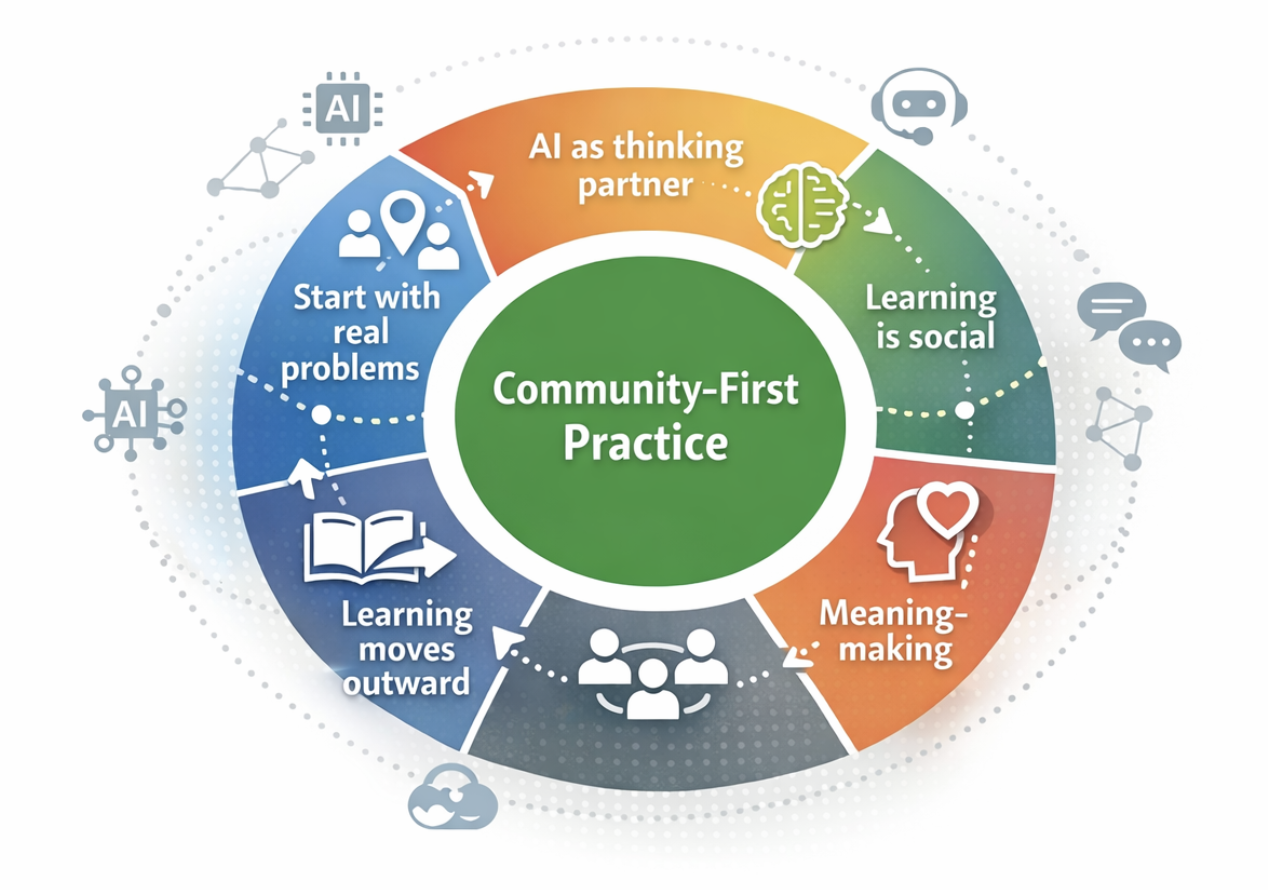
Community inquiry → AI-supported analysis → Collaboration → Reflection → Measurable growth.
That cycle is what makes the model transferable across disciplines and institutions.
Final Thought for Educators
If students leave your course with:
- Greater confidence navigating ambiguity
- Increased awareness of others’ lived realities
- Improved collaboration skills
- The ability to use AI critically rather than passively
You have prepared them for more than an exam.
You have prepared them for complexity.
And now you have tools to show it.


Leave a Reply