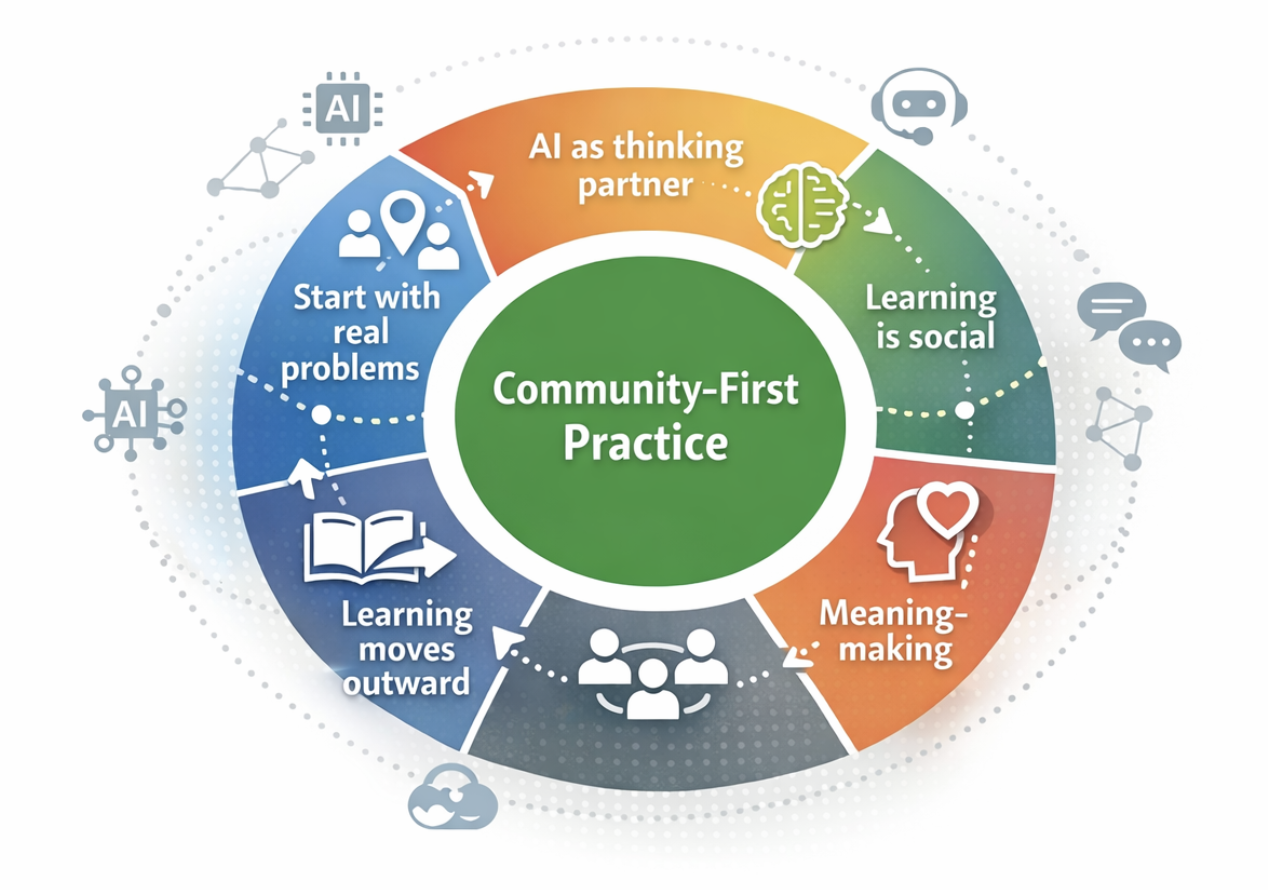
Designing Ethical, Reflective AI Integration in Community-Based Courses
Artificial intelligence is not the curriculum.
It is not the instructor.
It is not the learning outcome.
Used well, it is something quieter and more powerful: a scaffold for thinking.
In community-first courses—where students investigate real contexts, conduct interviews, analyze lived experiences, and reflect on ethical tensions—AI can support inquiry without replacing it. But only if we design intentionally.
This post offers a practical framework for integrating AI into community-based courses in ways that strengthen reflection, collaboration, and critical thinking while preserving student agency.
Step 1: Define AI’s Role Before Students Ever Use It
Most classroom friction around AI comes from ambiguity. Students do not know what counts as appropriate use, and faculty feel reactive rather than intentional.
Start by defining AI as one of three roles:
1. AI as Brainstorming Partner
Used for:
- Generating possible interview questions
- Suggesting alternative stakeholder perspectives
- Offering counterarguments
Not used for:
- Producing final conclusions
- Writing completed assignments
2. AI as Analytical Support
Used for:
- Clustering themes from interviews
- Summarizing reflection patterns
- Comparing multiple viewpoints
Students must:
- Verify patterns
- Identify inaccuracies
- Reflect on what AI missed
3. AI as Revision Coach
Used for:
- Improving clarity
- Strengthening organization
- Identifying gaps
Students must:
- Disclose use
- Explain what changes they accepted or rejected
When students understand the function of the tool, misuse declines dramatically.
The AI Integration Decision Matrix
Faculty often ask: Should I allow AI on this assignment?
Use this design matrix before the semester begins.
| Assignment Type | Allow AI? | Conditions | Why |
|---|---|---|---|
| Community interview questions | Yes | AI may suggest revisions | Encourages iterative thinking |
| Reflection journals | Yes | Students reflect on AI’s influence | Builds metacognition |
| Data analysis | Yes | AI clusters themes; students verify | Supports qualitative skills |
| Final synthesis paper | Limited | AI for revision only | Protects voice and authorship |
| Exams | No | Individual reasoning required | Preserves assessment integrity |
This shifts AI from an enforcement issue to a design choice.
Sample Syllabus Language (Faculty-Ready)
You are welcome to use AI tools in this course as thinking partners, revision coaches, and analytical assistants. AI may not replace your inquiry, interviews, reflections, or conclusions. If you use AI, you must disclose how you used it and reflect on what it contributed or limited. The goal is not avoidance of AI but ethical and intentional use.
Clarity prevents confusion.
Practical Classroom Examples
Here’s what ethical AI integration looks like in real courses.
Example 1: Business / Entrepreneurship
Assignment: Interview a small business owner about supply chain challenges.
Students:
- Conduct interview independently
- Upload transcript to AI tool
- Ask AI to identify recurring themes
- Compare AI themes with their own notes
Reflection prompt:
Where did AI identify something you overlooked?
Where did it oversimplify the complexity?
Outcome: Students practice qualitative analysis without surrendering interpretation.
Example 2: Sociology / Psychology
Assignment: Analyze community narratives around mental health access.
Students:
- Collect media articles or interviews
- Ask AI to summarize themes
- Identify missing voices
Reflection prompt:
What assumptions appear in AI’s summary?
What perspectives are absent?
Outcome: Students develop AI literacy alongside social analysis.
Example 3: English / Communications
Assignment: Draft persuasive brief on a community issue.
Students:
- Write initial draft independently
- Use AI to suggest structural improvements
- Compare versions
- Submit reflection on revisions
Outcome: Students retain authorship while improving clarity.
Reflection Is the Guardrail
AI use without reflection becomes automation.
AI use with reflection becomes literacy.
Add one short prompt whenever AI is involved:
- What did AI help you clarify?
- What did you disagree with?
- How did you verify its suggestions?
- What biases might be embedded?
These questions transform AI into a learning event.
Teaching Students to Notice AI Limitations
Students must experience AI’s flaws directly.
Encourage them to:
- Ask AI to analyze contradictory viewpoints
- Compare outputs across prompts
- Identify hallucinations or oversimplifications
When students see inconsistency firsthand, blind reliance decreases.
Collaboration + AI
In team projects, AI can:
- Generate role descriptions
- Draft project timelines
- Offer alternative solutions
But teams must:
- Document their process
- Reflect on decision-making
- Identify where human judgment prevailed
AI should accelerate thinking, not flatten it.
Why This Matters in Colleges
Community colleges serve diverse learners navigating work, family, and complex realities. AI integration must increase access and agency—not widen gaps.
Ethical AI design:
- Supports students with limited prior exposure
- Encourages digital fluency
- Builds workplace-relevant skills
- Reduces fear-based policies
When framed properly, AI becomes an equity tool rather than a surveillance trigger.
Final Design Principle
If AI replaces inquiry, redesign the assignment.
If AI deepens inquiry, keep it.
The goal is not to avoid AI.
The goal is to use it in ways that strengthen thinking, collaboration, and reflection.
Next in this series:
Measuring What Matters: Assessing Empathy, Self-Efficacy, and Collaboration in Community-First Learning


Leave a Reply