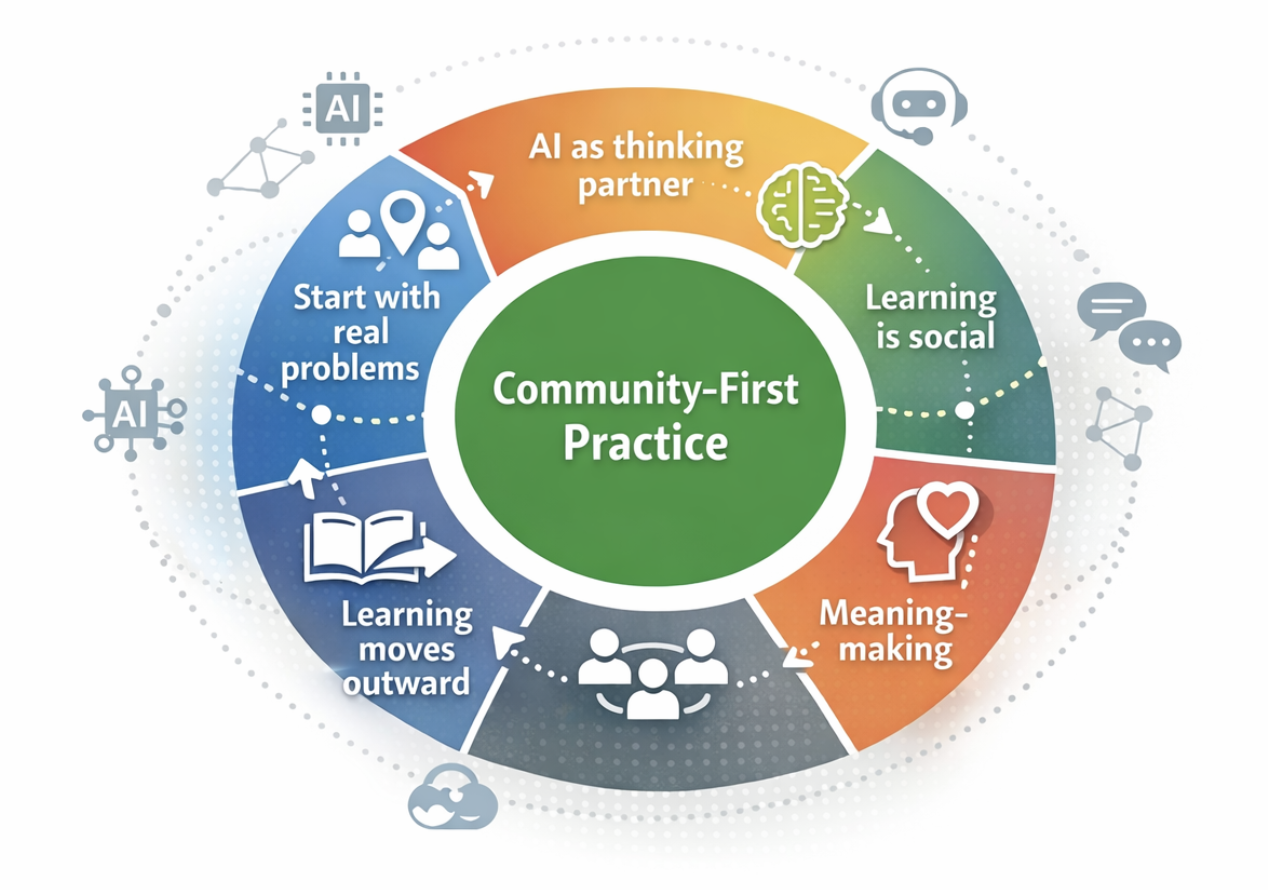
Designing Courses That Start with Real Problems, Not Syllabi
Community-First Pedagogy in the Age of AI Series
Introduction: Why I Started With Community Instead of Content
In 2022, a student asked me a question that stayed with me long after class ended. She said, “Is this something we would actually use?” She wasn’t pushing back. She wasn’t disengaged. She was working nearly full-time, helping support her family, commuting across the city, and trying to make every hour count. What she was really asking was whether her effort in this course connected to something real.
At the time, I had what most of us would consider a strong syllabus. Clear learning outcomes. Carefully sequenced readings. Structured assignments. I could explain how everything mapped onto theory and future careers. But I began to see something I couldn’t ignore: we were starting with content and asking students to trust that meaning would follow. For many of my students — first-generation, working, navigating layered responsibilities — that order felt disconnected from their lived reality.
The turning point wasn’t sudden. It grew out of years developing and refining the Citizen Entrepreneur Explorers Program (CEEP). CEEP was built on a simple but powerful premise: students learn best when they begin with their communities — not as abstract case studies, but as living systems of people, constraints, culture, and opportunity. The CEEP process guides students to discover a community issue, engage stakeholders, gather insights, reflect on positionality, and report back with ethical awareness. It treats inquiry as relational, iterative, and grounded in context.
What I realized in 2022 was that CEEP wasn’t just a co-curricular initiative or a structured project framework. It was a pedagogical anchor. Instead of asking, “What chapters do I need to cover?” I began asking, “What real community question can anchor this course?” Local businesses navigating rising costs. Neighborhood health decisions shaped by culture. Media narratives influencing perception. When courses began with the CEEP structure — community discovery before concept delivery — something shifted. Theory didn’t disappear; it became a tool students reached for because they needed it. They weren’t waiting for relevance. They were already inside it.
Around the same time, generative AI entered the classroom whether I invited it or not. Students were experimenting with it cautiously, sometimes quietly. My first instinct was concern. Would it shortcut inquiry? Replace effort? Undermine voice? But because CEEP already centered real-world engagement and reflection, AI had a boundary. It could not replace a stakeholder interview. It could not replicate lived context. It could not substitute for positionality reflection. Instead, when framed intentionally, it became a scaffold. Students used it to refine interview questions, compare thematic patterns, and challenge their own interpretations. And just as importantly, they began to notice its limitations. That noticing became part of the learning.
Over time, the impact became visible. Students who once hesitated to engage ambiguity grew more confident conducting interviews and navigating incomplete information. Their reflections revealed deeper empathy for stakeholders and more nuanced awareness of ethical trade-offs. Group projects became less transactional and more deliberative. These shifts were not accidental. They were structural — rooted in the CEEP cycle of discovery, engagement, reflection, and reporting. And because they were structural, they could be designed intentionally and assessed responsibly.
This three-part series grows directly out of that evolution. The first post explores how community-first design — grounded in CEEP — reframes course construction. The second examines how AI can function ethically within that structure as a scaffold rather than a substitute. The third offers practical tools for measuring growth in self-efficacy, empathy, and collaboration. Together, these posts articulate a model I have been refining through CEEP: learning as real work, grounded in community, supported by tools, and strengthened by evidence.
For me, this is not about chasing a technological trend. It is about honoring the core insight that launched CEEP in the first place: students deserve learning that begins with their world. When I think back to that student’s question, I can answer it differently now. Yes. This is something you will actually use — because it begins where you already are.
Most courses begin with a familiar question:
What content do I need to cover this semester?
Community-first teaching flips that question on its head and asks something more useful:
What problem are students learning with and for?
This shift does not require abandoning disciplinary rigor or learning outcomes. In fact, it often strengthens them. When students begin with real community contexts—local businesses, public services, cultural organizations, neighborhoods, or lived challenges—content becomes a tool, not the destination. Concepts gain purpose. Skills have stakes. Learning sticks.
This post offers a practical, course-design framework faculty across disciplines can use to anchor learning in community-first practice—whether you teach business, health, social sciences, humanities, STEM, or general education.
What “Community-First” Actually Means (and What It Doesn’t)
Let’s clear something up early.
Community-first does NOT mean:
- You must add service learning paperwork
- You need external partners lined up on Day 1
- Students must “fix” communities
- Every project leaves the classroom
Community-first DOES mean:
- Students investigate real contexts, not hypothetical ones
- Learning starts with observation, listening, and inquiry
- Problems are defined collaboratively, not imposed
- Reflection and ethics are built in from the start
Community-first pedagogy treats communities as sources of knowledge, not case studies to extract from.
The Community-First Course Design Framework
Think of this as a planning lens, not a rigid sequence.
Step 1: Start With a Community Question (Not a Topic)
Instead of:
- “This course covers marketing fundamentals”
- “This unit is about healthcare systems”
- “Students will learn research methods”
Try framing the course around a guiding community question.
Examples across disciplines:
- Business / Entrepreneurship
How do small local businesses adapt to rising costs without losing community trust? - Health & Human Services
How do cultural food traditions shape health decisions in this neighborhood? - Sociology / Psychology
What barriers affect access to mental health resources among young adults locally? - English / Communications
How are community voices represented—or missing—in local media narratives? - STEM / Environmental Studies
How do urban infrastructure decisions impact environmental risk at the block level?
Educator tool:
Write one guiding question that could plausibly matter to someone outside your classroom. If it wouldn’t matter beyond grading, revise it. Find more resources on Citizen Entrepreneur Explorer Program site.
Step 2: Map Learning Outcomes After the Question
This is where rigor comes back in.
Once you have the community question, map your existing learning outcomes onto it.
Example (Business Course):
Community Question:
How do neighborhood businesses balance growth and community responsibility?
Mapped Outcomes:
- Analyze business models → applied to real firms
- Practice data collection → interviews, observations, surveys
- Develop teamwork skills → group research roles
- Communicate findings → community-facing briefs or presentations
Nothing is lost. Everything is contextualized.
Educator tool: Community → Outcome Mapping Table
| Community Question | Course Outcome | Assignment |
|---|---|---|
| Local business challenges | Opportunity analysis | Interview + reflection |
| Stakeholder perspectives | Ethical reasoning | Positionality memo |
| Real constraints | Strategic thinking | Recommendation brief |
Step 3: Design Low-Risk Community Inquiry Activities
You do not need external partnerships to begin.
Community inquiry can be:
- Observational
- Interview-based
- Media-based
- Reflective
- Student-selected
Low-lift examples faculty use successfully:
- Students interview one person connected to the issue
- Students analyze publicly available data or reports
- Students conduct structured observations (spaces, services, interactions)
- Students reflect on their own positionality related to the topic
The goal is sense-making, not solutions.
Educator tool: Starter Inquiry Prompts
- What do people affected by this issue say they need?
- What constraints shape decisions here?
- What assumptions do I bring to this topic?
- What information is missing—and why?
Step 4: Use AI as a Scaffold, Not a Substitute
This is where community-first practice pairs naturally with ethical AI use.
AI works best after students have gathered something real.
Effective classroom uses:
- Helping students summarize interview themes
- Comparing multiple stakeholder perspectives
- Drafting questions for deeper inquiry
- Supporting revision and reflection
Less effective uses:
- Generating the problem for students
- Writing conclusions before inquiry
- Replacing human interpretation
Educator tool: AI Reflection Prompt
“Describe one way AI helped you see this community issue differently—and one limitation you noticed.”
This keeps agency with the student, not the tool.
Step 5: Build Reflection in From the Beginning
Community-first learning without reflection becomes extractive.
Reflection should not be an add-on at the end. It should be iterative and brief.
Examples of short, repeatable reflections:
- “What surprised me this week?”
- “What felt uncomfortable—and why?”
- “What would I ask if I had more time?”
- “How has my understanding changed?”
These reflections often reveal learning that exams never capture—especially empathy, ethical reasoning, and growth in confidence.
What This Looks Like in a Real Course (Concrete Example)
Course: Introductory Entrepreneurship / General Education
Community Question:
What challenges do small businesses face when serving diverse neighborhoods?
Student Activities:
- Week 1–2: Community observation + reflection
- Week 3–4: Interview one business owner or customer
- Week 5: AI-assisted theme analysis
- Week 6: Team discussion on ethical trade-offs
- Week 7: Short recommendation memo (not a full plan)
Assessment Focus:
- Quality of inquiry
- Depth of reflection
- Collaboration process
- Ability to connect experience to concepts
No pitch deck required. No unrealistic “solutions.” Just learning grounded in reality.
Why Community-First Works (Especially at Community Colleges)
Community-first pedagogy:
- Validates students’ lived experience
- Reduces abstraction anxiety
- Improves engagement and persistence
- Builds career-relevant skills naturally
- Creates space for ethical reasoning
Most importantly, it answers the student question we hear most often:
“Why does this matter?”
A Final Note to Educators
You don’t need to redesign your entire course tomorrow.
Start small:
- One question
- One inquiry activity
- One reflection
- One moment where students connect learning to the world they already inhabit
That’s community-first practice.
And once you start there, content stops feeling like something you deliver—and starts becoming something students use.
The materials developed for these posts were part of the BMCC Faculty Development Grant won in Fall 2025. All steps and materials can be downloaded from CEEP’s website.
The Full Grant Completion Arc (Three-Post Structure)
| Post | Purpose | Grant Goal Covered |
|---|---|---|
| 1. Community-First Before Content | Pedagogical design | Community-first OER expansion |
| 2. AI as Scaffold | Ethical AI integration | AI literacy + reflective tools |
| 3. Measuring What Matters | Assessment & dissemination | Self-efficacy, empathy, collaboration research |


Leave a Reply